
The garden already exists. A child in a coat. A moth. One night. Someone wants it on a phone for eight seconds.
If you say “make it vertical and cinematic,” you will get a different child, or a camera that panics, or a clip that is secretly three stills with a fade. That is not direction. That is weather.
A vertical clip is a shot. It has a frame, a duration, and one camera job. It should start from a still you would ship.
The thread after this essay is that order. One keyframe. Then /video with @out:garden-still.
Lock the night first
Do not animate a world you have not accepted. If the story needs several frames, /images holds the walk. If you only need the beat that will move, /image is enough.
Design one moon-garden keyframe: a child in a coat following a glowing moth, same palette as the story set, no readable text or logos.

The matching frames around it can stay rasters:
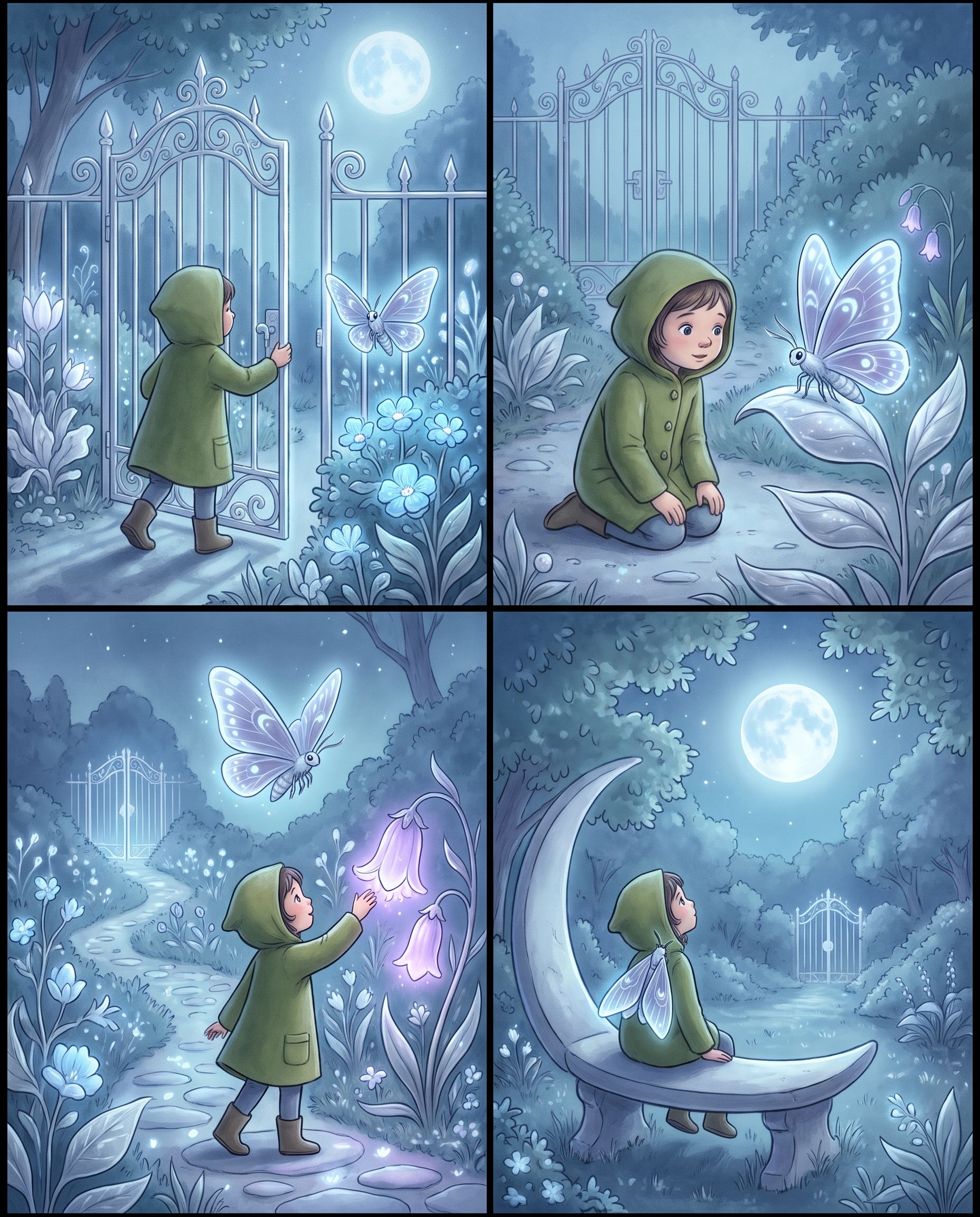

That sameness is When to use /image instead of /images. Motion does not get to break it.
Give the camera one sentence
Vertical is $aspect:9:16. Time is $duration:8. The move is English you would say to an operator.
The accepted child follows the moth a few steps. Slow, directed, same night. No overlays or readable text.
“A few steps.” Not a chase. Not a crane over the whole forest. The phone is close. The night stays the night.
@promptha.sora-2 is a pro motion route. Use it when the face has to stay the face. A quick route is fine when you are only testing the move — Quick, standard, and pro. How to pick a @promptha model is the selection essay. Public strings stay @promptha.*.
@out:garden-still is the previous result. If you skip it, you are rolling the dice on a new child.
Ban overlays. The title of the episode is /thumbnail or type in the Design Editor. A clip that writes on itself is a moving flyer with fake letters.
Directed versus random
Random looks busy. The camera breathes when it should hold. The moth becomes a sparkler. The child turns into a cousin. People call that “AI video” and mean it as an insult.
Directed looks cheap in the prompt and expensive on the phone:
- Who stays in frame
- What the camera does once
- How long
- What must not change
If the clip needs a beginning and an end, say the beat: she sees the moth, she takes two steps, she stops. If it needs to loop under a post, say loop, and do not end on a gesture that cannot restart.
A product reveal is the same grammar with a shoe. A dish is the same grammar with a bowl. The object you accepted is the subject. The camera serves it. That is How to ask for video without getting a still.
Two files, not one hero
Ship the still. Ship the clip. The cover is a third file if you need a grid thumbnail. Do not ask one /video to be the poster, the cover, and the story.
When you press play, watch for honesty. Did the coat stay the coat? Did the moth stay one moth? Did the camera do the one thing you asked? If not, do not “fix it in the prompt poem.” Change one clause. Attach the same @out: again.
The rest of the language is in What AskGL is. The command map is the command list. School for routes is AskGL models.
Then open Ask. Accept the night. Ask for eight directed seconds. The phone will know the difference.
Frequently asked questions
Why not let the model pick the camera?
Because random cameras invent a different night. Name one move. Slow follow, locked off, or a small push. Not all three.
Is a vertical clip a storyboard?
No. Four matching stills are /images. A clip is time. If you need both, accept the stills, then attach one with @out:.
Which speed should I use?
Quick is a draft of the move. Pro is when the subject has to stay the subject. That split is Quick, standard, and pro.

